
What importers and distributors should settle before buying Indonesian fish crackers in bulk: raw or fried, fish content, expansion, moisture, packing and food documents.
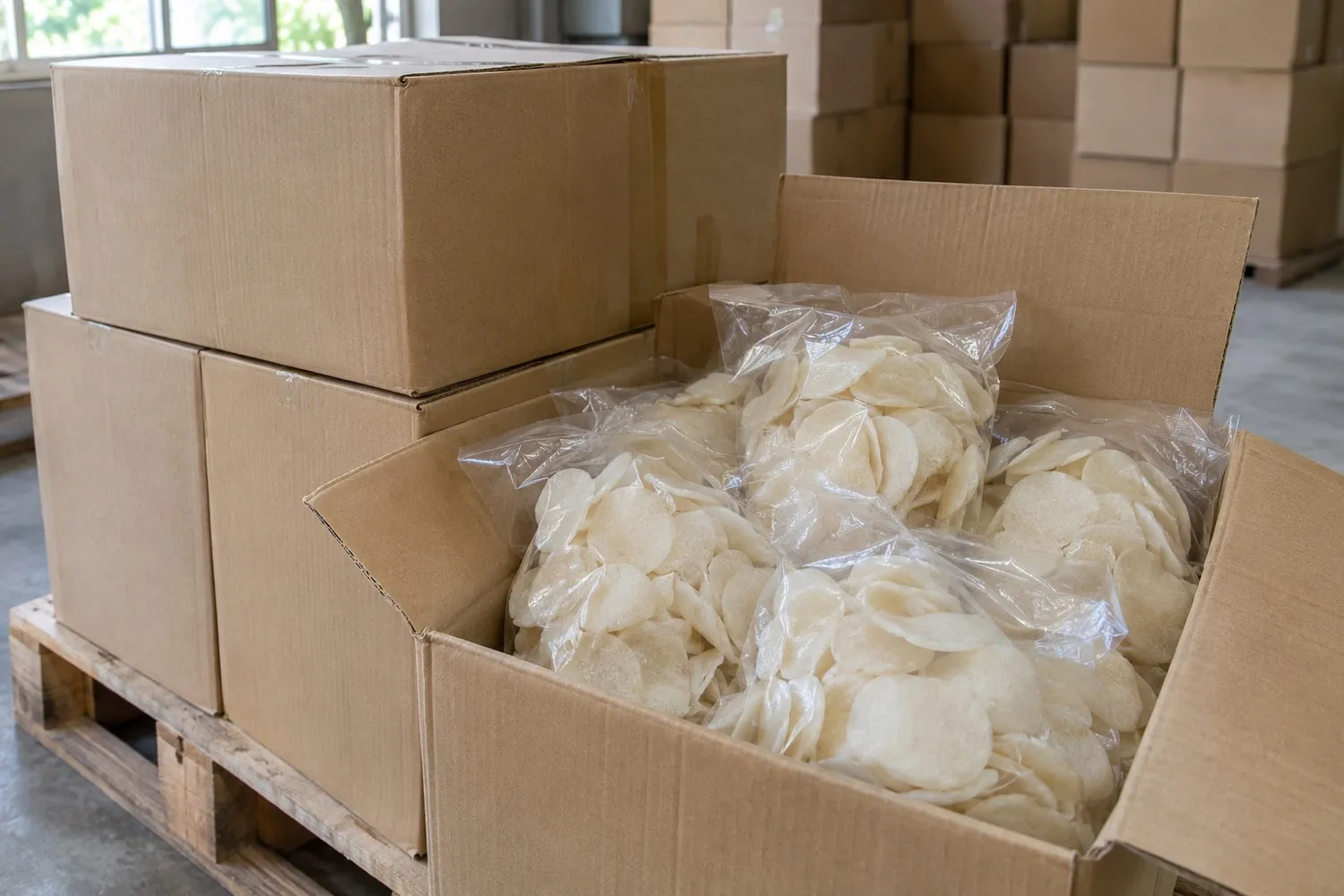
Buying fish crackers in bulk from Indonesia comes down to four decisions: raw slices or fried crackers, how much fish the recipe really carries, how far the crackers should expand in the fryer, and how they will be packed for your market. Put those on paper and two quotes become comparable. Leave them out and "fish crackers" can describe products with very little in common.
This guide is for importers, Asian food distributors and private-label brands buying by the pallet or the container. If you are still putting together a first enquiry, our fish cracker enquiry checklist is the better place to start. Here we go further into what to specify and what to test.
Raw or fried: this decides most of what follows
Raw crackers, called kerupuk in Indonesia and keropok in Malaysia, are dried slices of a steamed fish and starch dough. Someone still has to fry them before they are eaten, whether that is a restaurant, a co-packer or the end customer. Fried crackers are ready to eat and usually reach the shopper in a sealed bag. IDB offers both from Java and Kalimantan, in bulk or retail packing, as listed on our fish crackers page.
The practical gap between them is large. Raw slices are compact and hold up well in transit, but your customer needs a fryer. Fried crackers are ready for the shelf, but they have already puffed up, so a container fills with air long before it reaches its weight limit. They also break more easily, and the frying oil they carry can go stale, which makes the bag itself part of the product.
So start from your customer. A distributor supplying Asian restaurants in the Netherlands will probably want raw slices in catering cartons. A snack brand going into supermarkets is more likely to want fried crackers in printed bags, or raw crackers fried by a co-packer close to the market.
Ask what "fish content" actually means
The recipe is fish plus starch, usually tapioca, with salt and seasoning, and the share of fish varies widely. A Universiti Sains Malaysia survey of commercial keropok found protein running from about 5.5% to 15.8%, and the authors read that figure as what separates high-fish products from low-fish ones. That is Malaysian data, so take it as a picture of how wide the range can be, not as a target for Indonesian goods.
More fish is not automatically better. In a Gadjah Mada University trial using tilapia and tapioca at ratios from 30:70 to 60:40, higher fish ratios reduced expansion during frying and scored lower on acceptability. A strong fish flavour and a big, airy cracker pull against each other, so decide which one your market is paying for.
Then ask for things you can check: the fish percentage in the recipe, the species, and a laboratory protein result. Words like "premium" or "high fish" tell you nothing until they are tied to a number.
Fry the sample before you commit
With raw crackers, expansion is the quality your customer notices first. The same Malaysian survey measured linear expansion from about 38% to 146%, so this is a real difference between products. It is also easy to test. Measure a slice, fry it the way your customer will, and measure it again. A 40 mm slice that comes out at 70 mm has expanded 75%. Do this on several slices, record the result against the sample reference, and repeat it on a pre-shipment sample if you take one.
Moisture sits behind much of this. The Gadjah Mada crackers expanded well at a starting moisture of about 8.5% to 11.2%, and the Malaysian commercial samples ran from about 9.4% to 13.8%. These are research figures, not a specification, so agree your own maximum with the supplier and say when it is measured. Raw crackers that pick up damp can fry poorly and risk mould, and fried ones simply go soft.
- Form: raw or fried, plus shape and slice size.
- Recipe: fish species and fish percentage.
- Laboratory results you want: protein and moisture, with the limits written as numbers.
- Expansion: your minimum, and the frying method used to test it.
- Flavour and colour, matched to an approved sample.
Packing, shelf life and container space
IDB lists a 12-month shelf life for fish crackers. Confirm that for your exact product and pack, and ask when the clock starts, because transit and slow distribution both use it up. If your own customers require a minimum remaining shelf life on arrival, put that in the contract rather than assuming it.
IDB plans fish cracker loads by volume instead of quoting a fixed tonnage. Ask for carton dimensions, net and gross weight per carton, and cartons per container for the format you have chosen. Our guide to working out a container load shows how to run the numbers. The answer will look very different for raw slices and fried bags, so compare landed cost per kilo, not just the price per carton.
For retail packs, labelling has to meet the food rules of the destination country, and IDB checks label compliance before packaging is printed. Send your label requirements early, since reprinting bags is slow and wasteful. Fish is a declared allergen in the United States, where the label must also name the species, so the recipe information above feeds straight into the artwork.
Food documents to settle before you order
Fish crackers are a food containing fish, so expect more questions at the border than with a dry spice. What applies depends on your destination and on how the product is classified there. Ask your customs broker or food authority first, then write their list into your request.
In the United States, for example, FDA seafood rules cover any food in which fish is a characterising ingredient. Unless the origin country has a qualifying agreement with FDA, the importer needs written verification procedures, which can include the processor's HACCP records, certificates from an authority or competent third party, or product testing. If your crackers fall under those rules, you will want that paperwork from the producer before the order is placed, not after it lands.
IDB is a trading company, so ask which producer each lot comes from, because certificates generally belong to the producer and the lot. If your market expects a health certificate, a laboratory analysis or a halal certificate, name it at the start so the quotation only covers lots that can meet it.
Getting a quotation
Ask every supplier to quote on the same delivery term and named port, or the figures will not line up. Our note on FOB and CIF explains the difference.
IDB can help you source Indonesian fish crackers and prepare a bulk or container order, from agreeing form, recipe and sample through to packing, export documents and loading. Send raw or fried, the fish content or flavour you need, your packing format, estimated volume and destination port through the IDB enquiry form, and the trade team will come back with what fits and the next steps.
Sourcing fish crackers? Specifications, packing and container loads are on our Indonesian fish crackers supplier page.