
Indonesian local cardamom needs a clear type, grade, and end use before a workable export quotation can be prepared.
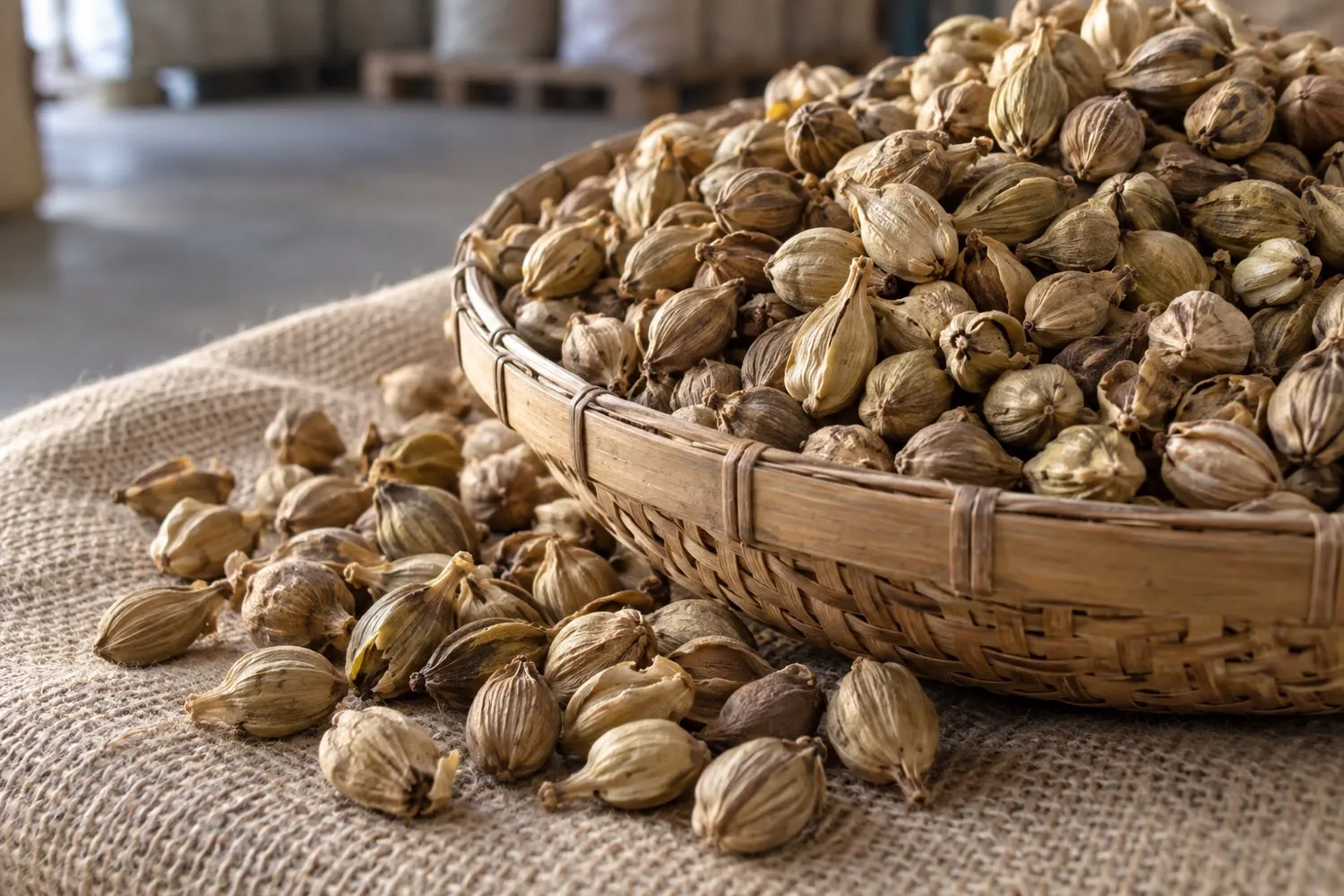
For an overseas buyer, Indonesian cardamom is not a single, interchangeable item. The local dried cardamom traded from Indonesia differs from green Indian cardamom in both size and aroma. A buyer who asks simply for cardamom may therefore receive an answer that is technically correct yet unsuitable for the intended use.
The useful question is what the cardamom must do in the buyer's process. Is it for further processing, a product blend, or another application? Which grade is needed? What volume and destination are under discussion? A clear enquiry gives both sides a common basis for checking the goods and preparing a quotation.
PT Imexindo Dua Bersaudara is a trading company. We collect cardamom from its source regions in West Java and Sumatra, check the grade, arrange packing, and prepare shipment to the agreed terms. The current commodity page for Indonesian cardamom gives the starting specification.
What Indonesian cardamom means in an export enquiry
In Indonesian, cardamom is called kapulaga. In an export enquiry, however, the English name alone does not settle the product. The request should say whether the buyer seeks dried local Indonesian cardamom and should state the end use where it matters. That small distinction prevents a broad commodity name from hiding a real difference in type.
The product handled here is dried local cardamom in pod form. A buyer comparing suppliers should make that point explicit rather than assume all cardamom offers refer to the same material. It is better to clarify the type before samples and quotations are compared than to find that two offers use the same word for different goods.
Consistent wording also helps purchasing, quality checking, and shipping teams read the same requirement. Keep the product description in the correspondence and use it when samples, packing, and contract terms are discussed. Where a buyer uses an internal product name, add a short explanation of the pod form and intended use so that no party gives the term a different meaning.
Local cardamom, sabrang cardamom, and green Indian cardamom
Local cardamom differs from kapulaga sabrang and green Indian cardamom, particularly in size and aroma. This is not merely a naming issue. Those characteristics affect suitability for a buyer's application and the way a sample is assessed. Treating every type as generic cardamom can create an avoidable mismatch before a transaction has even begun.
The safest approach is to state the intended use in the enquiry. Buyers needing a particular character for their process should say so. Buyers still assessing options can ask specifically about dried Indonesian local cardamom. We can then match the enquiry to the type being collected and checked, rather than assume that one cardamom type can replace another.
This is also why samples and written descriptions need to be read together. A photograph can show the general form, but it cannot replace an agreed description of type and grade. In cross-border trade, an imprecise term may become a costly issue only after the goods arrive.
What decides the grade at inspection
Cardamom quality is more than the first visual impression when a bag is opened. Inspection should connect the physical condition of the goods with the buyer's use. For dried local cardamom, IDB states a maximum moisture content of 12%. That is a useful starting point for discussing dryness, but the requested grade still needs to be set out in the enquiry.
- Maximum moisture of 12% as the stated base specification for dried local cardamom.
- Size sorting, so that the offer has a clear basis for inspection.
- Even dryness, so the condition is not judged from a small and unrepresentative part of the lot.
- Export grade or industrial grade, matched to the end use supplied by the buyer.
Export and industrial grades should not be treated as labels that can be exchanged without context. An industrial buyer may have its own downstream process, while another buyer needs a different appearance or degree of uniformity. The same discipline appears in our guide to pepper export grades: a grade has to become criteria that both parties can inspect.
At goods receipt, the inspection record should return to the agreed specification rather than a general impression that the lot looks satisfactory. This gives the buyer a basis for evaluating the quotation and gives the trader the same basis while collecting and checking goods from source regions. It matters particularly where the shipment will enter a process that cannot readily be changed after arrival.
Before a quotation is prepared, state the quality parameters that are genuinely required. A point that has not been agreed should not be treated as though it were part of the transaction basis. This keeps inspection tied to requirements that are clear to both parties.
Packing and container planning
Dried local cardamom is packed in 40 kg bags. As a commodity planning guide, a 20-foot container carries roughly 11 tonnes. This is a reference point, not a promise that every order will load to exactly that amount. The agreed specification, load arrangement, and documentation needs can all affect the shipment plan.
For a buyer, those details help test whether the proposed volume fits the packing and shipment pattern. They should not be used to set a minimum order without first discussing the requirement. A smaller enquiry or a different packing request needs its own discussion so that the quotation does not create the wrong expectation.
Once the specification and volume are clear, the export process can be mapped for the shipment. Goods move only after the permissions and documents needed for that shipment are ready. In that sequence, packing is not simply a warehouse detail. It is part of a shipment plan that can be checked.
What to include before a quotation
A quotation is only comparable when the underlying information is comparable. State the cardamom's end use, requested grade, estimated volume, and destination country. For the product type, say whether you need dried local Indonesian cardamom rather than only writing cardamom. Those details let us assess the match and the scope of handling.
At first contact, the IDB process asks for the goods, estimated volume, and destination country. The information is then completed before a single figure to the agreed delivery point is prepared for negotiation. Contract and payment follow an agreement; export permissions and documents are issued before the goods move. See the full sequence in how to order.
If you are assessing cardamom for a particular use, send that specification with the volume and shipping destination. We can check the suitability of available local cardamom and prepare the quotation discussion around your requirement, rather than around a general commodity name.