
Kapok is the hollow seed fibre of the Ceiba pentandra tree. Where Indonesian kapok grows, how it gets from pod to pressed bale, and what that path means for the fibre you buy.
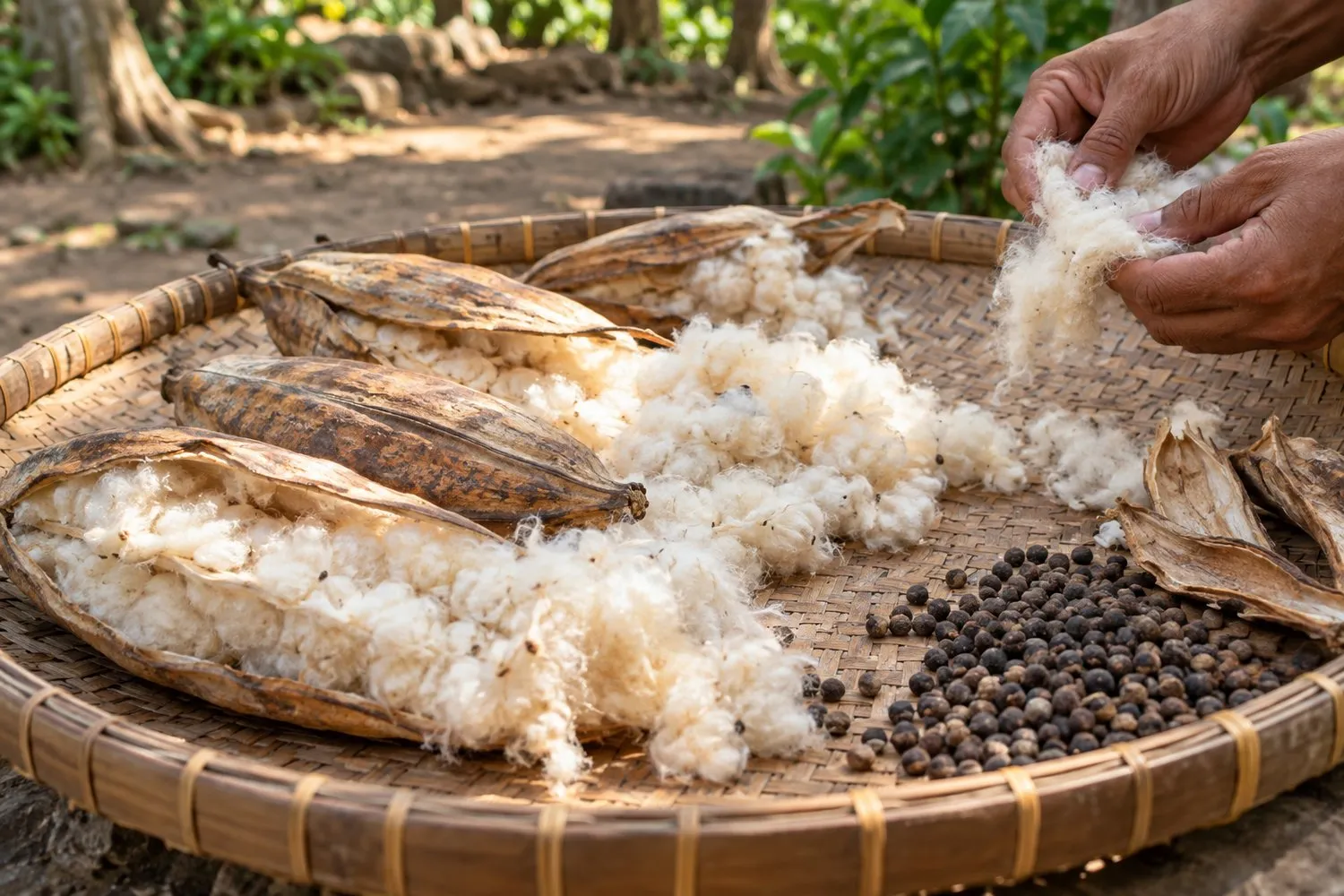
Kapok is the soft, silky fibre that grows inside the seed pods of the kapok tree, Ceiba pentandra. It is not spun from a plant stem like jute, and it is not cotton, although it is sometimes sold as "Java cotton" or "silk cotton". Each fibre is a thin, hollow tube with a natural waxy surface. That is why kapok feels almost weightless, floats, and sheds water, and why it ends up as loose filling in pillows, mattresses, cushions and buoyancy products rather than as yarn.
For a buyer, the definition is only half the story. Most of the world's kapok comes from Indonesia, and the way it is harvested and cleaned in Java decides much of what arrives in your warehouse. This guide explains what the fibre is, where it grows, and what happens to it between the tree and a pressed bale.
What kapok fibre actually is
The kapok tree produces long, woody pods. Inside each pod, the seeds sit in a mass of fine fibres that grow from the inner wall of the pod. In the wild, those fibres carry the seeds away on the wind once the pod splits. In trade, the fibres are what you pay for and the seeds are a by-product.
Under a microscope, a kapok fibre looks like a drinking straw with a very thin wall. The hollow centre is mostly air, which gives kapok its loft and its low weight for the space it takes up. The waxy coating keeps water out, so the fibre dries quickly and stays buoyant. The same features make it short and slippery, which is why kapok is very hard to spin and is almost always used as fill.
Kapok, kapuk and randu: the names you will hear
In Indonesia the fibre is called kapuk, and the tree is randu. Suppliers often say kapuk randu, which simply means kapok from the randu tree. If you are reading Indonesian offers or packing lists, the guide to Indonesian commodity names covers these terms alongside the spice and coconut names.
The botanical name is the safest reference on a contract. Ceiba pentandra is the species traded as kapok across Southeast Asia. The tree is native to the tropical Americas and West Africa and has been planted in Java for a long time, often along roads, field edges and village boundaries rather than in large single-crop estates.
Where Indonesian kapok grows
Indonesia produces around seventy per cent of the world's kapok, and most of it comes from Java. The main growing and collection areas are Pati and Jepara in Central Java, along with several districts in East Java. That is where IDB's kapok suppliers are, and where fibre is gathered from many small holdings before it is cleaned and pressed.
The scattered way the trees are grown matters for buyers. A single container of kapok is rarely the harvest of one farm. It is assembled by collectors from many villages, which is why consistency between lots depends more on how the fibre is cleaned and checked at the collection point than on where the trees stand.
There is also a gap between growing and exporting. Indonesia ranks only thirteenth as a kapok exporter. Much of the crop is used at home, and part of what does leave goes through China, Vietnam and Bangladesh, where it is re-sorted and sold on under another country's name. If you have bought kapok before, some of it may well have started in Pati or Jepara.
From pod to pressed bale
The path from tree to container follows the same broad steps across the growing areas, even if the tools differ from one collector to the next.
- Harvest. Pods are taken once they have ripened on the tree, before they split open and the fibre blows away. The tree is not cut down and fruits again in later seasons.
- Drying and opening. The pods are dried, then broken open so the fibre and seeds can be pulled out. Some kapok is sold at this stage as whole or opened pods.
- Separating the seed. The fibre is worked by hand or in a beating or tumbling machine so the heavier seeds drop out. Husk pieces and twigs are removed at the same time.
- Bringing moisture down. The cleaned fibre is dried further. On IDB's kapok specification the limit is 12 per cent moisture, because damp kapok can heat inside a closed container on a long voyage.
- Pressing. The fibre is pressed into bales, typically 100 kilograms each, to fit as much as possible into the container.
Each step leaves its mark on the finished fibre. Seed separation that is rushed leaves hard dark flecks a pillow maker's customers will feel through a thin cover. Drying that is cut short shows up as a high moisture reading. A loose press means fewer kilograms in the box.
Why the cleaning stage sets the grade
Kapok has no international grade comparable to the ASTA standard for pepper. Two offers both described as premium can mean different fibre. In practice, buyers judge kapok on three things: moisture, foreign matter such as residual seed, pod husk and twigs, and how clean the fibre looks and feels when a handful is pulled apart. All three come straight out of the cleaning and drying steps above.
This is also where the price gap between offers is widest. Cleaned fibre costs more at source than pod kapok, but pod kapok takes far more container space for the same weight of usable fibre, and the cleaning then happens at your end. For a buyer without a cleaning line, cleaned fibre is usually the simpler purchase. How the filling compares with cotton and polyester in finished products is covered in kapok, cotton or polyester filling.
What this means when you buy
Because kapok is so light, a container runs out of space long before it reaches its weight limit. A 20ft container holds around four tonnes and a 40ft high cube around nine, so the 40ft high cube is the usual unit and the tightness of the press affects your cost per kilogram almost as much as the price of the fibre. A physical sample tells you more than any grade name, so agree the moisture and foreign matter limits against a sample before you contract. The step-by-step order process is in the guide to importing kapok fibre from Indonesia.
IDB sources kapok through its supplier network in Pati, Jepara and East Java and can help you go from a first sample to a full container: matching cleaned fibre or pod kapok to your end use, agreeing moisture and foreign matter limits, and working out the bale count for your load. Send us what you plan to make, the cleanliness you need, your target volume and your destination port. The full specification is on our kapok fibre page, and we will come back with what can be supplied and how it would load.