
How green coffee travels from an Indonesian warehouse to your port by container: bag choice, container type, moisture at loading and how to limit container sweat.
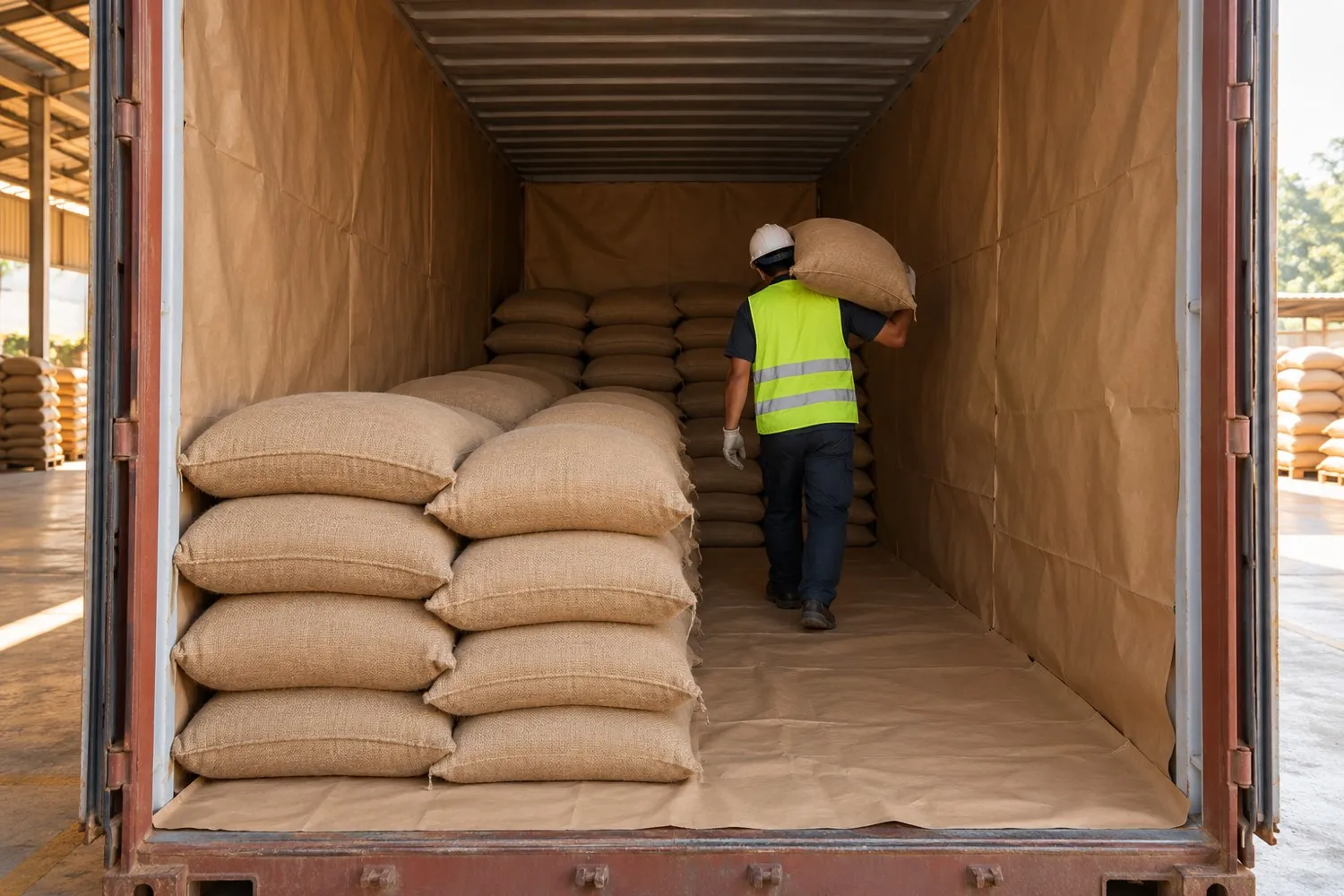
Green coffee is still a living, moisture-sensitive product when it leaves Indonesia. Between the exporter's warehouse and your receiving dock it spends weeks in a steel box that heats up by day, cools at night and crosses several climate zones. Most quality complaints that appear on arrival, such as damp bags, musty odour or mould on the top layer, start with decisions made before the container doors were closed.
This guide is for importers, distributors and commercial roasters buying Indonesian coffee by the container. It covers the parts of shipping you can actually specify: the bag, the container, the moisture of the coffee at loading, the way the box is prepared, and what your team should do when it arrives. The buying process itself, from origin to contract, is covered in our guide on how to import green coffee beans from Indonesia.
How green coffee is usually packed for export
The standard export pack is a new woven sack of natural fibre, usually jute. The German insurers' cargo handbook, TIS (Transport Information Service of the GDV), describes the net weight as generally 60 kg per bag. IDB's own green coffee page lists the same format: Arabica and Robusta from Sumatra, Java and Sulawesi, packed in 60 kg jute bags, with a 20ft container carrying around 18 tonnes.
Jute is used for a reason. It lets the beans exchange air with their surroundings, so moisture does not stay trapped against the coffee. The drawback is the same property: a porous bag offers little protection if the air inside the container turns damp. That is why the bag is only one part of the packing decision.
Some buyers ask for an inner liner, often a hermetic bag placed inside the jute. Hermetic liners are marketed as a way to keep moisture and oxygen out during transit and storage. Whether one is worth the extra cost depends on your coffee, your storage time after arrival and how your team handles opened bags. If you want liners, say so in your enquiry so the packing can be quoted and prepared correctly, rather than added after the offer is agreed.
Bagged, bulk or ventilated: choosing the container
Most bagged coffee ships in a standard dry container. Two alternatives come up in buyer discussions, and each changes how the shipment is prepared.
- Standard container with bags. The common choice. Bags are stacked by hand, so the stow, the paper lining and the count can all be checked during loading.
- Bulk in a liner bag. TIS notes that roughly a third of containerised coffee moves as bulk cargo in 20ft standard containers, with a plastic liner bag hung inside and filled while the container is tilted. This suits buyers whose receiving plant can unload and handle loose beans.
- Ventilated container. Sometimes called a coffee container, it has openings along the side walls and in the floor and roof areas so outside air can move through the cargo. It is used where the moisture of the coffee is high enough to make a closed box risky.
Your choice should match what your warehouse can receive. A bulk liner saves bag handling at origin, but it only helps if your site has the equipment to discharge it. If you are unsure how many bags or tonnes your volume represents, our note on working out a container load explains how weight and space limits interact.
Why container sweat is the main risk
Container sweat is condensation that forms on the inside of the steel walls and roof when the air in the box cools below its dew point. The water then drips onto the top layer of bags. Coffee loaded in a warm, humid tropical port and carried towards a cooler destination goes through exactly the temperature swings that cause it.
TIS calls the prevention of condensation absolutely essential for coffee cargo. The UK P&I Club, in its Carefully to Carry guidance on coffee, recommends lining containers with heavy-duty kraft or corrugated paper, covering the floor and the top of the stow of bags. The paper does not stop condensation forming, but it absorbs and spreads the first drips before they reach the coffee.
Two practical points follow from those sources. First, do not cover the cargo with plastic film or tarpaulin; TIS warns that this can trap moisture against the coffee. Second, ventilation openings should not be sealed, since the UK P&I Club lists sealed vents among the causes of condensation damage. Desiccant strips are also sold for containers. Treat them as an addition to correct moisture and lining, not a replacement for either.
Moisture at loading: the figure to agree in advance
The moisture content of the coffee when it goes into the container drives most of the risk. TIS gives typical loading moisture of 11 to 13 percent, with up to 13.5 percent still acceptable. Between 13.5 and 14 percent, it considers ventilated containers essential and calls for very fast unloading at destination.
In practice, this means the moisture limit belongs in your specification, together with the method used to measure it. Agree whether a reading is taken at the warehouse before stuffing and how the result is shared with you. If a lot tests above your limit, decide in advance whether it is held for further drying, replaced, or shipped in a different container type. Settling this before loading avoids a dispute about who should have noticed.
- Agree a maximum moisture content and the measuring method in the contract.
- Ask for the pre-shipment moisture reading for the lot that is being loaded.
- Confirm the container type if the coffee is near the upper end of your limit.
- Keep the reading with the sample approval and contract records.
What to check when the container is stuffed
Stuffing is the last moment anyone can still change the shipment. Before loading, the container should be clean, dry and free of odours, since coffee picks up smells easily. Any holes or damaged door seals let water in during the voyage.
During loading, ask for confirmation that the paper lining covers the floor, the walls and the top of the stow, that the bag count matches the packing list, and that the bags are dry and undamaged. TIS also advises against using hand hooks on coffee sacks, as they tear the jute. Photos of the empty lined container, the half-loaded stow and the closed doors give your team and your insurer a useful record. The paperwork that travels with the goods is covered separately in documents before your first export.
Receiving the coffee at destination
The risk does not end when the vessel berths. A container that sits for days in a cold yard, or travels a long distance by truck after discharge, can cool quickly and sweat again. TIS recommends a transport temperature generally between 10 and 20 °C and advises unpacking promptly, ideally within 24 to 48 hours of arrival.
Brief your forwarder and warehouse before the shipment arrives. Ask them to open the doors promptly, check the top layer and the paper lining, and record any wet bags with photographs before the cargo is moved. If damage is found, the records from stuffing and receipt together show where the problem began.
Putting the shipping requirements into your order
None of these points is unusual, but they are easy to leave unsaid. A short shipping section in your enquiry, covering bag type, any liner, container type, moisture limit and the loading photos you want, gives the exporter a clear brief to quote against.
IDB can help you source Indonesian green coffee and prepare it for a container shipment, from agreeing the bag format and loading checks to export preparation at origin. Send your Arabica or Robusta requirement, estimated volume, destination port and any packing or moisture requirements through the IDB enquiry form, and the trade team will discuss a suitable lot and how it can be packed for your route.
Sourcing coffee beans? Specifications, packing and container loads are on our Indonesian coffee beans supplier page.