
For mattress, bedding and filling manufacturers buying kapok by the container: choosing clean fibre or pod kapok, judging a sample when there is no world grade, and planning a load that runs out of space before weight.
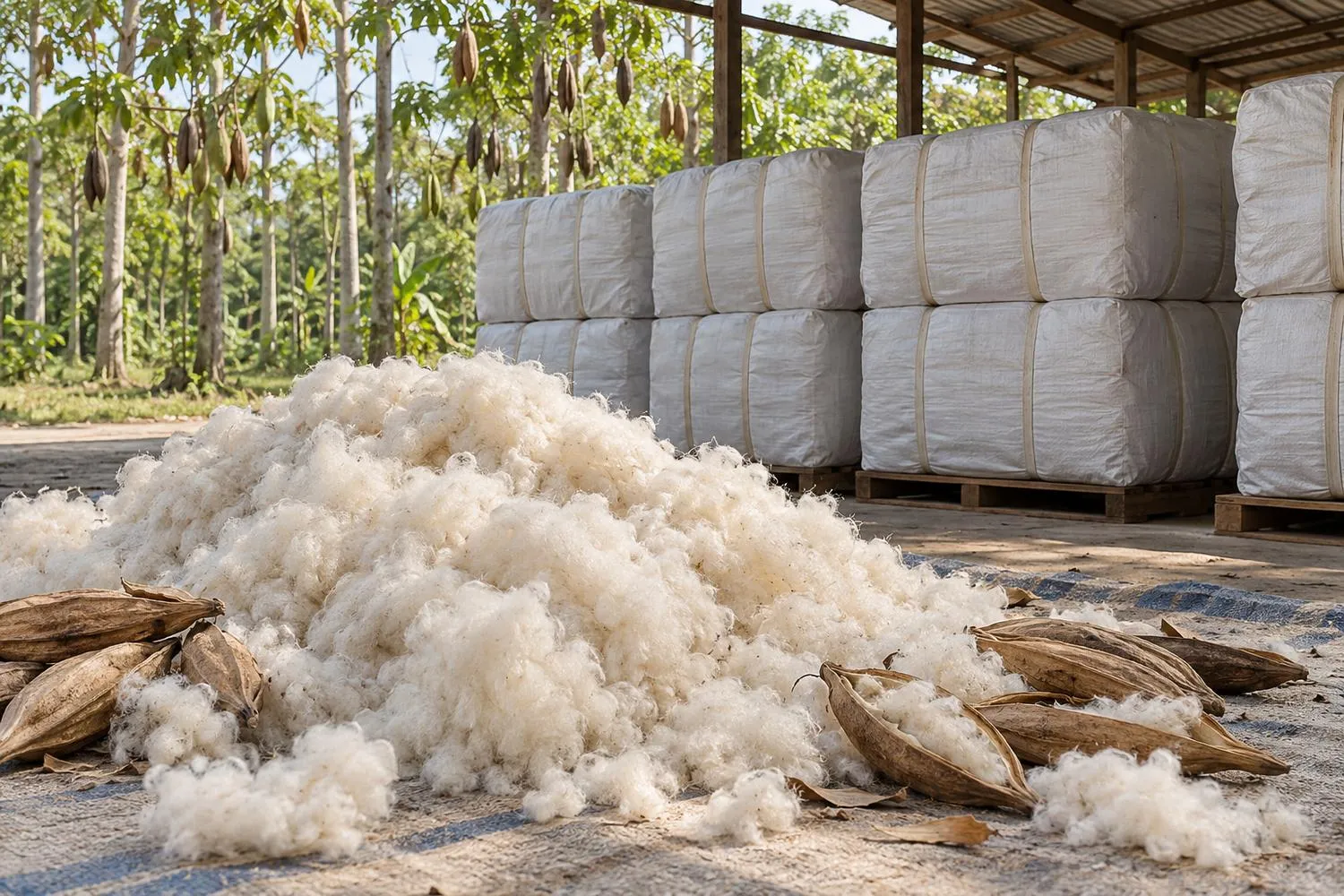
Importing kapok from Indonesia looks simple on paper. Indonesia grows around seventy per cent of the world's kapok, the fibre is light and easy to handle, and most of it comes from a few districts in Java. The difficulty sits elsewhere. There is no international grade to quote against, and a container fills by space long before it nears its weight limit. A first order that ignores either point usually ends with a disappointing sample or a freight bill that makes the fibre look expensive.
This guide is for manufacturers and distributors who buy by the container: bedding and mattress makers, pillow and cushion producers, and traders supplying them. It follows the order a first shipment usually takes: end use, form, sample, packing and container, then terms and the check before loading.
Why so much Indonesian kapok reaches you second-hand
Indonesia produces most of the world's kapok, yet ranks only thirteenth as an exporter. Part of the harvest is used at home. A good share of the rest leaves through China, Vietnam and Bangladesh, where it is re-sorted and sold on under another country's name. If you have bought kapok before, there is a fair chance some of it started in Pati or Jepara in Central Java, or in East Java.
Buying directly removes that middle layer, but it also removes the sorting the hub did for you. That is the trade-off. A direct buyer has to say clearly what clean means for their factory, because nobody downstream will re-grade the fibre before it reaches the production line.
Start with the end use, then choose the form
Kapok is the seed fibre of the kapok tree. It is hollow, very light and naturally water-resistant, which is why it ends up as filling for pillows, mattresses and cushions, and in buoyancy and insulation products. Each of those uses tolerates a different amount of leftover seed and husk. A pillow maker whose customers feel every hard fleck needs cleaner fibre than a buyer packing it into an insulating layer.
That end use decides the first real choice: clean fibre or raw pod kapok.
- Clean fibre has had the seeds, pod husk and twigs taken out before pressing. It goes straight into production with little or no further sorting.
- Raw pod kapok still carries much of that material. It can be cheaper at source, but it takes far more space for the same weight of usable fibre, and you do the cleaning at your end.
- If you have your own cleaning line, ask for both prices. If you do not, pod kapok rarely saves money once freight is counted.
Foreign matter is where the price gap between the two is widest, so stating the form in your first message is worth more than any adjective about quality.
There is no world grade, so the sample does the work
Pepper has the ASTA standard. Kapok has nothing comparable. Two suppliers can both offer premium kapok and mean quite different fibre. In practice kapok is judged on three things: moisture, foreign matter and how clean the fibre is.
Moisture matters more than first-time buyers expect. Kapok takes up damp quickly, and a damp bale can heat inside a closed container on a long voyage. On IDB's kapok specification the ceiling is 12 per cent moisture. Foreign matter means residual seed, pod husk and twigs. Fibre cleanliness is what you see and feel when you pull a handful apart: colour, loose dust and broken fibre.
Because none of this fits neatly into a grade name, the physical sample becomes the reference for your contract. Ask for a sample before you sign, and ask which lot it represents. When it arrives, have the person who will actually use the fibre look at it, not only purchasing. Then reply with a plain decision: accepted, rejected, or accepted with stated changes. That decision is what the later shipment is checked against.
Pressed bales and the 40ft high cube
Here is where most first calculations go wrong. Kapok is so light that a 20ft container runs out of room at around four tonnes, against a weight limit of roughly 28 tonnes. You are paying for a box that is mostly carrying air. A 40ft high cube holds around nine tonnes, more than twice the payload without a matching rise in freight.
Two things follow from that. First, for nearly every kapok order the 40ft high cube is the sensible unit, and suppliers will usually quote the minimum order as one container. Second, how tightly the fibre is pressed matters as much as its price per kilo. For export, kapok almost always ships as pressed bales, typically 100 kilograms each, rather than as loose fibre. The tighter the press, the more fits in the container and the lower your landed cost per kilogram.
If you want to see the arithmetic against a dense cargo, the note on working out a container load shows how volume and weight trade off. Ask your supplier for the bale size and an estimated load per container before you compare offers, because two quotes with the same price per kilo can mean very different costs once the bales are counted.
Terms, documents and payment
Ask for every offer on a named Incoterm. IDB quotes FOB, CFR or CIF from Indonesian ports and puts the Incoterm on the first line of the offer, which makes competing quotes comparable. If this is your first import from Indonesia, FOB keeps the split of responsibilities simplest.
For agricultural cargo, a phytosanitary certificate and a certificate of origin come as standard. If your market needs more, such as a laboratory moisture result, say so before contract so it can be arranged before shipment. What your own country requires at the border is something your customs broker should confirm early; it is easier to add a document before loading than after the vessel sails.
Payment is usually an advance or a letter of credit, agreed in the sales contract together with the grade, quantity, schedule and what happens if the cargo misses the agreed specification. The general order steps are set out on how to order.
The check before loading, and repeat orders
The last chance to catch a problem cheaply is before the bales go into the container. IDB checks quality before stuffing, seals the container with the inspector present, and sends loading photographs, a quality report and the container and seal numbers. Use that report the way you used the sample: compare it against what you approved, and raise anything unclear before the vessel leaves.
Once the first shipment has been received and used, write down what worked. Note the bale size that suited your warehouse, the moisture reading on arrival, and how much sorting your line still had to do. That short note turns the next order into a repeat rather than a new negotiation. If you plan regular shipments, share the schedule early so collection from growers can be arranged ahead of time.
If you are still comparing sources, the guide on choosing an Indonesian commodity supplier covers what to ask before you commit to anyone, IDB included.
Planning a kapok order with IDB
IDB sources kapok through its supplier network in Central and East Java and can help you set up a first container order: matching the fibre form to your end use, sending a sample before contract, and working out the bale count for a 40ft high cube. Send us the end use, the moisture and foreign matter you can accept, your target volume and your destination port. You can see the full specification on our kapok fibre page, and we will come back with what can be supplied and how it would load.