
For pillow, mattress and cushion makers choosing a fill: how kapok compares with cotton and polyester on loft, weight, moisture, ageing and allergen claims, and what changes when you buy kapok by the bale.
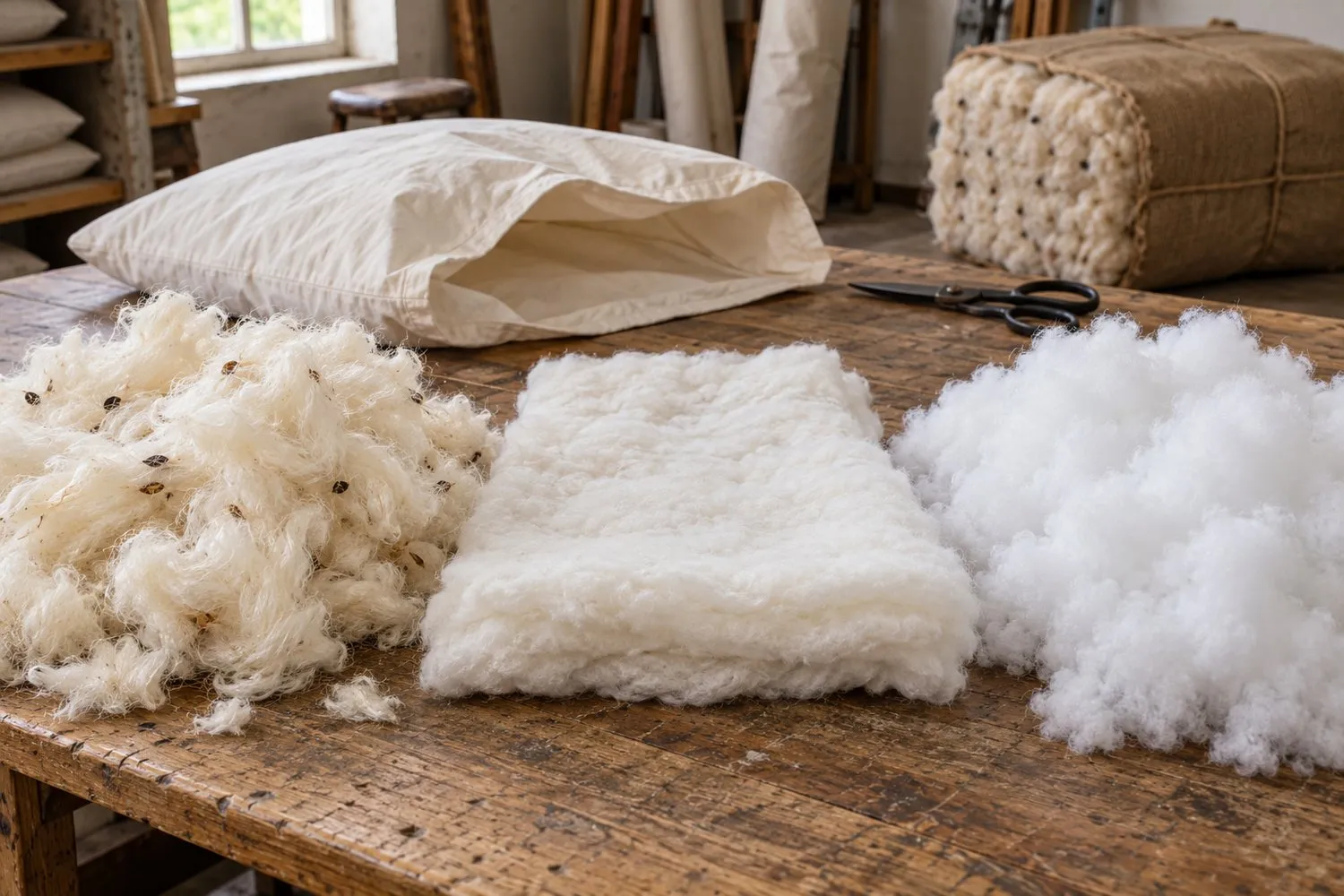
Is kapok a better filling than cotton or polyester? For some products, clearly yes. For others, it is the wrong choice. Kapok is lighter than both, sheds moisture instead of soaking it up, and gives a soft, slightly shifting feel that suits pillows, bolsters and floor cushions. It also flattens with use, needs plumping, and is messier to handle on a production line than either alternative. Which of those points matters most depends on the product you make and the customer you sell to.
This guide is for pillow, mattress, cushion and bedding manufacturers weighing up a kapok filling against the two fills they probably already use. It compares the three on the points that come up in product development, then covers what is different about buying kapok as a raw material from Indonesia, where most of the world's supply is grown.
Three fibres that start from very different places
Kapok is the seed fibre of the kapok tree, Ceiba pentandra. Each fibre is a thin, hollow tube with a natural waxy coating. That structure explains most of its behaviour: the trapped air makes it very light and buoyant, and the coating makes it shed water. The fibres are short and slippery, which is why kapok is hard to spin into yarn and ends up as loose fill instead.
Cotton fill is the same plant fibre used for fabric, opened into batting or loose fill. It is solid rather than hollow, so it is denser and heavier for the same volume, and it absorbs moisture readily. Polyester fibrefill is man-made, extruded from polymer and often from recycled PET. Because it is manufactured, it can be produced in hollow, siliconised or conjugated grades tuned for loft and recovery, and one batch behaves very much like the next.
Loft, feel and how each one ages
Pick up a kapok pillow and a cotton pillow of the same size and the difference is obvious: the kapok one feels almost weightless. Kapok gives a soft, mouldable support that moves a little under the head, which many buyers of natural pillows like and some find too loose. Cotton feels firmer and flatter from the start. Polyester sits between them and can be adjusted by choosing the fibre grade.
Ageing is where the three part company. Cotton slowly compacts into a dense, firm layer, which is why traditional cotton mattresses and futons need turning. Kapok compresses too, but it can be fluffed back up by hand or by airing it in the sun, and that routine is part of owning a kapok pillow. Over a long life, kapok fibre slowly breaks down into finer particles. Polyester recovers its shape well while new, though cheaper grades tend to clump after repeated washing.
For a product designer, that suggests a simple split. Kapok suits items the end user handles and reshapes: pillows, bolsters, meditation and floor cushions, soft toys. Cotton suits firm, layered products such as futons and traditional mattresses. Polyester suits products sold on uniformity and easy care.
Moisture, warmth and washing
Kapok's waxy coating means it does not hold water the way cotton does, so it dries quickly and stays light in humid rooms. The open, hollow fibres also let air move, which is why kapok bedding has a reputation for sleeping cool. Cotton breathes well too, but once it takes up moisture it stays damp for longer and becomes heavier. Polyester does not absorb much water, though some sleepers find dense synthetic fill holds more heat.
Washing is the practical weak point of both natural fills. Loose kapok and cotton are not designed to go through a washing machine, so most makers give them a removable, washable cover and tell customers to air the insert instead. Polyester pillows are often sold as fully machine-washable, and if that is a selling point in your range, kapok will not replace them like for like.
Allergen and natural claims: what you can stand behind
Kapok is often marketed as a natural, plant-based alternative to synthetic fill, and that description is accurate: it is a seed fibre with no chemical processing needed to make it usable. Claims that go further, such as hypoallergenic or resistant to dust mites, are a different matter. Whether they hold for your product depends on how clean the fibre is, what cover you use, and what your own testing shows. A batch with a lot of residual seed and husk dust will not support a sensitivity claim, however natural it is.
Flammability deserves an early conversation too. Kapok burns readily, as loose natural fibres generally do. If your products must meet a flammability standard in your market, plan the cover fabric or barrier layer around that before committing to the fill, rather than discovering it at certification.
Working with kapok on the production floor
Kapok is easy to stuff by hand but awkward at volume. Its fine, light fibres float in the air as soon as a bale is opened, so most workshops fill kapok in an enclosed area or with a blowing machine and dust extraction. Teams moving over from polyester often need to adjust their filling equipment, because kapok does not flow through blowers the way synthetic fibre does.
Fill weight also needs rethinking. A pillow that takes a certain weight of polyester will need a noticeably different weight of kapok to reach the same loft, and the right figure only comes from trial pieces. Plan a short sampling run before you write a bill of materials.
Buying kapok as a filling material
There is no international grade for kapok, so the specification is something you agree with the supplier. It usually comes down to three points: moisture, foreign matter and fibre cleanliness. On IDB's kapok specification, moisture is capped at 12 per cent, because damp fibre can heat inside a closed container. Foreign matter means residual seed, pod husk and twigs, and for pillow makers it matters most, since customers feel hard flecks through a thin cover.
Kapok for export ships as pressed bales, typically 100 kilograms each. Because the fibre is so light, a container runs out of space long before it reaches its weight limit: a 20ft takes around four tonnes and a 40ft high cube around nine. That is why the 40ft high cube is the usual unit, and why the tightness of the press affects your cost per kilogram as much as the price of the fibre itself. The guide to importing kapok fibre from Indonesia covers the order steps, and the note on preparing a kapok quotation request shows what to include in a first enquiry.
IDB sources clean kapok fibre from growing areas in Central and East Java, including Pati and Jepara, and can help you move from trial pieces to a first container: sending a sample to test against your current fill, agreeing moisture and foreign matter limits suited to pillows or mattresses, and working out the bale count for your load. Tell us the product you are filling, the cleanliness you need, your target volume and your destination port. The full specification is on our kapok fibre page, and we will come back with what can be supplied and how it would load.