
For most dry commodities from Indonesia the practical minimum order is one 20ft container. Why that is, what one container means in tonnes, and what to do if you need less.
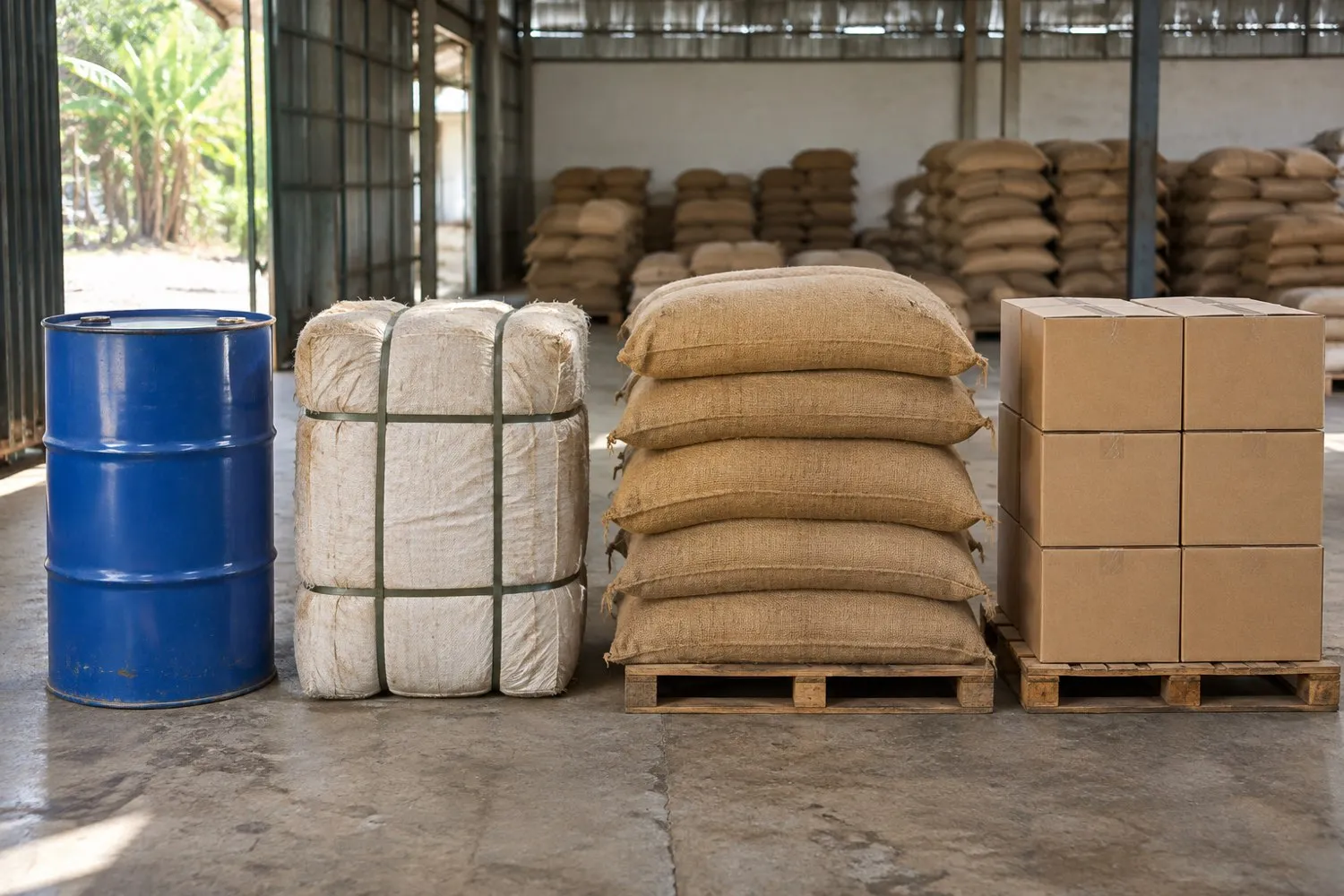
Ask an Indonesian commodity exporter for the minimum order and the answer is usually a container, not a number of kilograms. For most dry goods such as spices, the practical minimum is one 20ft container. Light goods like kapok are also sold by the container, though the tonnage is far lower. A few high-value products, patchouli oil for one, can start from a single drum.
That can be frustrating if you had 500 kg or two tonnes in mind for a first order. The container minimum is not a supplier being awkward. It follows from how the costs of an export shipment fall, and once you see where they sit you can judge whether a smaller order is worth asking for and how to ask.
The short answer, by type of goods
These are the starting points IDB gives on its own commodity pages. They are planning figures, and the quantity for your order is confirmed in the quotation.
- Spices and other dry bagged goods: normally one 20ft container. Some buyers take consolidated cargo instead.
- Kapok fibre: one container, and nearly always a 40ft high cube rather than a 20ft.
- Coconut charcoal briquettes: one 20ft container, around 18 tonnes.
- Patchouli oil: one 180 kg drum, shipped alone or in a consolidated load.
Why the container is the unit
Sea freight for a full container is charged per container, not per kilogram. Whether the box holds 16 tonnes of cloves or four, the line charges for the box. The same is true of much of the work around a shipment. The phytosanitary certificate, the certificate of origin and the export declaration are prepared per shipment. So are the pre-loading quality check and the trucking to port.
Spread across a full container, those costs are a small part of each kilogram. Put them on two tonnes and they can decide whether the order makes sense at all. A supplier who quotes by the container is really telling you the size at which the price per kilogram becomes competitive for you.
There is a quality reason too. Commodities are collected from farmers and collectors, then sorted and checked as one lot against one specification. A lot sized to a container is easier to keep uniform, and easier for you to inspect, than a small parcel split off from somebody else's order.
One container is not one quantity
This is where first enquiries often go wrong. A 20ft container holds about 33 cubic metres and carries up to roughly 28 tonnes, and your load stops at whichever limit comes first. Dense goods get close to the weight limit. Bulky goods run out of room long before it.
IDB's reference loads for a 20ft container show the spread. They are indicative, and stowage and packing move them:
- White pepper in 25 kg or 50 kg bags: around 18 tonnes.
- Dried cloves in 50 kg bags: around 16 tonnes.
- Cassia cinnamon in bales or bags: around 12 tonnes.
- Dried cardamom in 40 kg bags: around 11 tonnes.
- Kapok in 100 kg pressed bales: around 4 tonnes, limited by space.
So a one-container minimum for cardamom is a much smaller commitment in tonnes than the same minimum for pepper. Kapok is the extreme case. A 20ft fills at about four tonnes, which is why the usual unit is the 40ft high cube at around nine. If you want to check the arithmetic for your own packing, our note on working out a container load walks through a worked example.
The practical point: when a supplier says one container, ask how many tonnes that means for this commodity in this packing. Then compare it with what you can sell or process before the goods age.
If you need less than a container
The usual route is consolidated cargo, often called LCL, where your goods share a container with other shippers' cargo. It lets you start without waiting for your volume to build up. The trade-off is a higher cost per kilogram, because the freight and the fixed paperwork are carried by fewer kilograms.
Take a spice blender who needs three tonnes of cloves a quarter. One option is a consolidated shipment every quarter. The other is a full 20ft once a year, around 16 tonnes, with the stock held in the blender's own warehouse. Which is better depends on storage, cash flow and how long the goods keep their quality. That calculation belongs to the buyer, and a supplier can only help once it knows the real pattern of demand.
If you buy two or three commodities, it is also worth asking whether they can travel in one container. Whether that works depends on the goods and on your own country's import rules, so raise it at the enquiry stage rather than after the quotation.
One thing a small order is not: a sample. A sample is a small parcel sent so you can test and approve the goods before a contract. It is not priced or handled like a shipment, and approving it does not replace the order that follows.
When value is high, the minimum shrinks
The container logic weakens as the value per kilogram rises. Patchouli oil is the clear example in IDB's range. Freight is such a small share of the price that a single 180 kg drum, shipped alone or consolidated, still makes sense. First orders usually go that way. A 20ft container of around 14 tonnes is for buyers whose volume has become regular.
The useful question is therefore how much of the landed cost is freight and paperwork for your product. For bulky, lower-value goods the answer is a great deal, and the container minimum is firm. For concentrated, high-value goods there is far more room.
What exporters cannot do below the minimum
An export shipment of five or twenty kilograms does not really exist in commodity trade. The documents, inspection and handling are the same as for a full lot, so the cost per kilogram ends up far above what a local wholesaler would charge. If you need a few bags for a shop, a small workshop or a product trial, a distributor or importer in your own country is the right source. They are the ones who buy by the container.
Direct import starts to make sense when you can take at least a consolidated lot, and it works best at a full container.
How to ask about minimum order so you get a useful answer
The question "what is your MOQ?" on its own gets a one-line reply. Give the supplier enough to plan with and the answer becomes specific to you:
- The commodity, grade and intended use.
- The volume you want per shipment, and roughly how much you use in a year.
- How often you expect to buy.
- Whether consolidated cargo is acceptable for a first order.
- The destination port, and the packing you can receive.
With those five lines a supplier can tell you whether a full container, a consolidated load or a phased plan fits. It can also quote one price against the delivery term you choose. The sequence from enquiry to loading is set out in how to order.
Planning a first order with IDB
PT Imexindo Dua Bersaudara is an Indonesian trading company. IDB can help you source Indonesian commodities and size a first order that works on freight, whether that is a full container, a consolidated load or a single drum of oil. Send the commodity and grade, your volume per shipment and per year, and your destination port through the IDB enquiry form. The trade team will work out the load and come back with the options for your order. The commodity pages list the reference packing and container load for each product.