
The clauses an importer should settle in a sales contract for Indonesian commodities before the first container: specification, quantity tolerance, inspection, delivery terms, payment and claims.
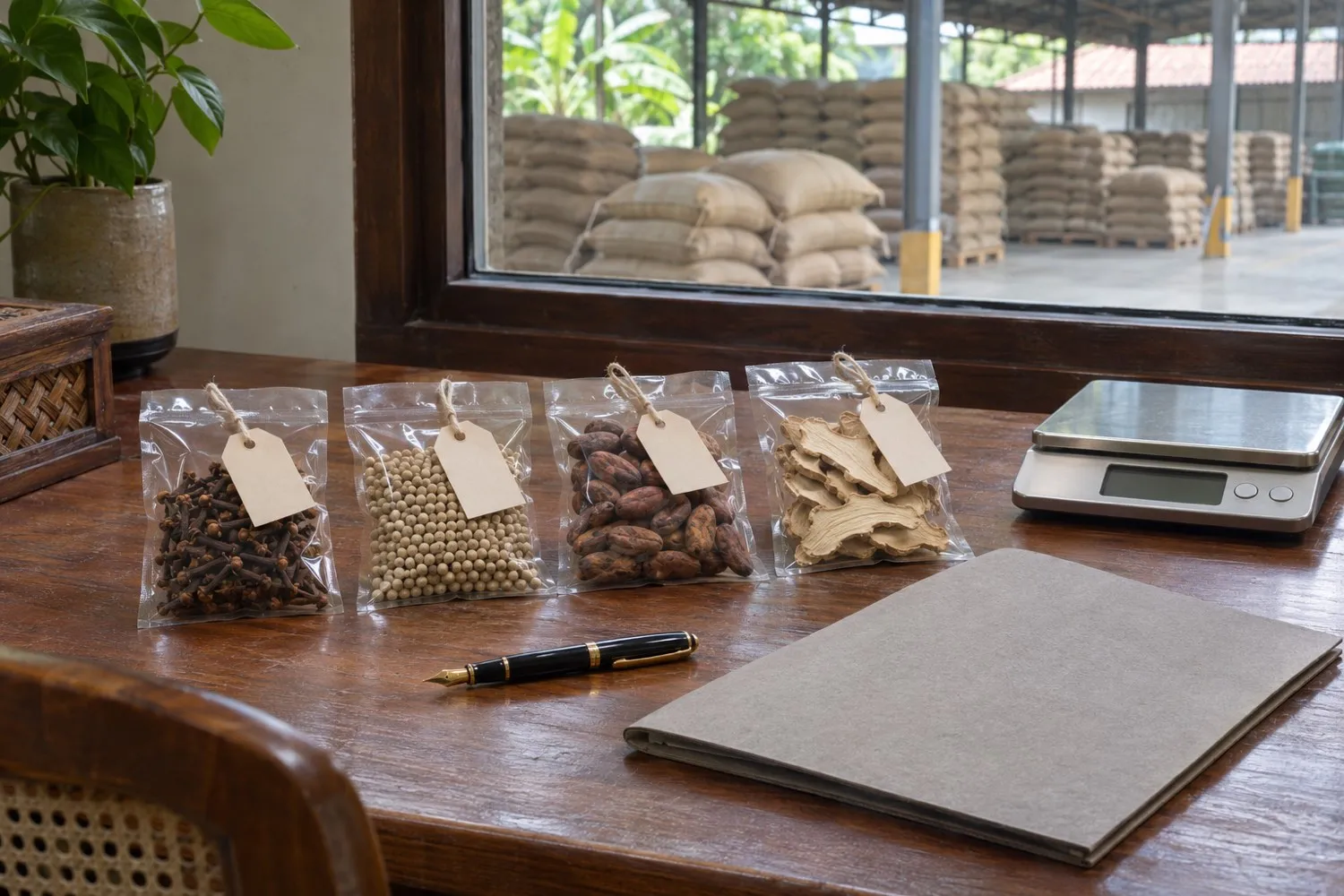
A sales contract for Indonesian commodities does one job: it turns a conversation about spices, beans or fibre into terms both sides can check. For a first shipment, six points carry most of the weight. The goods and their specification, the quantity and how much it may vary, where and how quality is inspected, the delivery term, how and when payment is made, and what happens if the cargo arrives outside the agreed figures.
Price usually gets settled first because it is the number everyone is watching. The disputes that actually hurt tend to come from the other clauses, the ones written in a hurry or left to email. Here is what each of those clauses should say, and why it matters more on a first order than on the tenth.
Describe the goods so a stranger could check them
The product clause should name the commodity, its origin and its form in the words your own customers use. "Indonesian cloves" is a start. "Dried whole cloves, Sulawesi origin, maximum moisture 12%" is a description someone at the destination port can hold the cargo against. The same goes for grades: if the offer says FAQ or ASTA, export grade or industrial grade, the contract needs to say what that grade means in measurable terms, not just repeat the label.
List the parameters your team will actually test. For most dry commodities that means moisture, admixture or foreign matter, broken or damaged pieces, and something specific to the product, such as bulk density for pepper or the cut test for cocoa. Each limit should be a number, with the method or the moment of measurement attached. A moisture figure measured at the warehouse in Indonesia and the same figure measured after five weeks at sea are not the same promise.
Finally, link the description to the approved sample. Write the sample reference into the contract and keep sealed duplicates on both sides. If the goods are later questioned, both parties can open the same reference instead of arguing from memory.
Quantity, tolerance and the weight that counts
Commodities rarely load to the exact kilogram. Bags settle, moisture shifts slightly, and the last few bags may or may not fit. That is why commodity contracts usually allow a small percentage more or less than the contracted quantity, and state who chooses within that range. Agree the percentage before signing and confirm it applies to the invoice as well as the loading.
Then decide which weight is final. Shipped weight means the figure recorded at loading in Indonesia stands. Landed weight means the buyer's weighing at destination decides, which shifts the risk of loss in transit. Either can work, but the contract has to pick one, and the packing should be stated with it: bag type, net weight per bag and the number of bags per container.
Inspection: where, by whom, and with what evidence
Inspection is the clause that protects both sides, so it is worth being specific. Say whether a pre-shipment inspection is required, who performs it, and what the report must cover. On IDB shipments, quality is checked before the bags go into the container, the container is sealed with the inspector present, and loading photographs, the quality report and the container and seal numbers are sent to the buyer. If your market asks for laboratory results, such as moisture, volatile oil or microbiological limits, name them in the contract so they can be arranged before the cargo moves.
Agree as well which certificates travel with the goods. On agricultural cargo a phytosanitary certificate and a certificate of origin are standard. Anything your import authority or your own customers ask for beyond that should be listed now, because certificates are issued before shipment, not after.
Delivery term and timing
Every price should sit on a named Incoterm, with the loading port and the edition stated, for example FOB followed by the named Indonesian port, Incoterms 2020. The term decides who books the vessel, who insures the cargo and at what point the risk moves to you. If you are unsure which to choose, our guide to FOB vs CIF walks through the difference.
For timing, a shipment period works better than a single date, for example shipment in the second half of a named month. It reflects how vessels and inland trucking actually run in Indonesia and gives both sides a clear test of whether the seller delivered on time. Pair it with the offer validity, since commodity prices move and an offer accepted after it lapses is a new negotiation.
Payment that follows evidence
Payment terms for Indonesian commodities are usually an advance payment, a letter of credit, or a mix of both. IDB works with advance payment or an irrevocable letter of credit, agreed case by case. Whatever the method, tie each step to something you can verify. A deposit on contract, the balance against the loading report and shipping documents, for instance, keeps neither side exposed for long.
If you pay by letter of credit, make the credit match the contract word for word. Letters of credit are normally issued subject to UCP 600, and banks check documents against the credit, not against the goods. A product description in the credit that differs from the invoice, or a document the seller cannot obtain in Indonesia, can hold up payment even when the cargo is perfect. Send a draft of the credit to the seller before your bank issues it.
Claims, and what happens if things go wrong
The claims clause should answer three questions: how many days you have after arrival to raise a quality or weight claim, what evidence is needed, and what the remedy is. Evidence is usually an independent survey at destination, drawn and sealed in a way both sides accept, read against the approved sample. Remedies range from a price allowance for a minor shortfall to rejection of the lot when the goods are clearly outside specification. It helps to name the threshold between the two.
Close with the general terms: force majeure, which law governs the contract, and where disputes are settled. Some trades work on standard forms from trade associations such as GAFTA for grain and feed or FOSFA for oils and fats. For a spice or fibre purchase, a short bilateral contract that covers the points above is often clearer than borrowing a form written for a different commodity.
Keep the first contract small and clear
A first contract with a new supplier is also a test of how the other side works. A trial volume, often a single 20ft container for spices, lets you check the specification, the inspection report and the paperwork before committing to a longer programme. Our note on minimum order explains why the container is usually the smallest practical unit, and the how to order page shows where the contract sits in the full sequence from enquiry to loading.
IDB can help you source Indonesian commodities and set up a first container on terms that are written down and checkable, from agreeing the specification and sample to inspection, export documents and loading. Send the commodity and grade you need, your estimated volume, your preferred Incoterm and the destination port through the IDB enquiry form, and the trade team will come back with an offer and the next steps for your order.